Thứ Ba, 31 tháng 5, 2016

Hà Trí Hiếu Paints Rural Peace in the City

HaTriHieu


In the Studio: The Gang of Five painter on ongoing conversations with his canvases and how the countryside has absorbed the vices of the city
A cramped maze lies between Khâm Thiên street and the Temple of Literature. Slim houses and makeshift shacks hosting all-you-could-possibly-need shops snuggle up to 1960s style apartment buildings in faded Hanoi yellow. One of these houses Hà Trí Hiếu’s studio. But when the painter opens the smaller than norm door in a dark, narrow hallway on the first floor visitors step into an unexpected oasis of light, a seemingly impossible amount of space and a welcoming atmosphere of lingering conversations among friends.

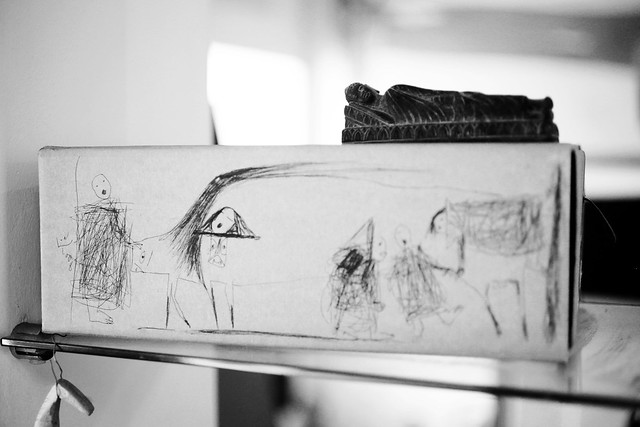
The Gang of Five member has created his signature paintings at this very spot for 20 years. Visitors to Hà Trí Hiếu’s studio are engulfed by his art with paintings from throughout his career filling up all the available space. Buffaloes of all sizes, country girls and self-portraits fill canvases of all sizes that are stacked 10 deep against each wall. A large portion of the other things filling up the rest of the space also bear Hieu’s brush and pen stroke. Intricate sketches on whiskey bottle boxes, CD covers, a single shoe horn and envelopes make this space endlessly fascinating and impossible to tire of.
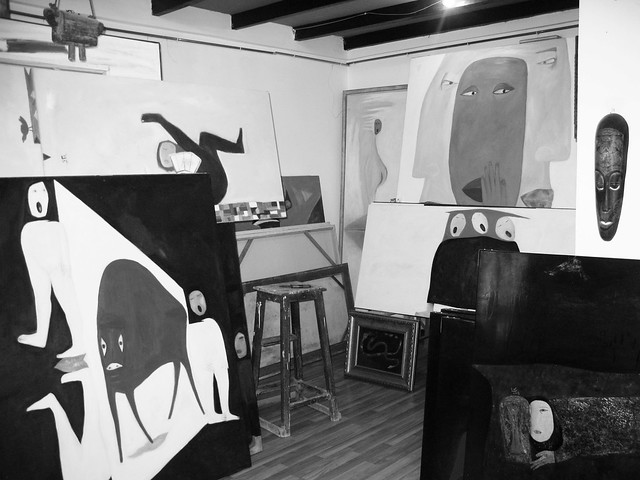
In the Studio with Hà Trí Hiếu

The top layers of art works are the unusually dark and muted lacquer paintings Hiếu will exhibit at the Heritage Space in the Dolphin Plaza from 5 – 31 July. It is the first time the artist has dabbled with lacquer. But there is no mistaking that this is Hiếu’s work as his ever present muse, the countryside, is present in this latest series as well.

& Of Other Things spent an afternoon with this most charming and amiable of men nosing through his studio, getting excited about the possibility of a Gang of Five reunion exhibition and only leaving with our photographer intact thanks to the attentiveness of our interviewee who made sure the visiting Englishman had a fan pointed at him at all times.
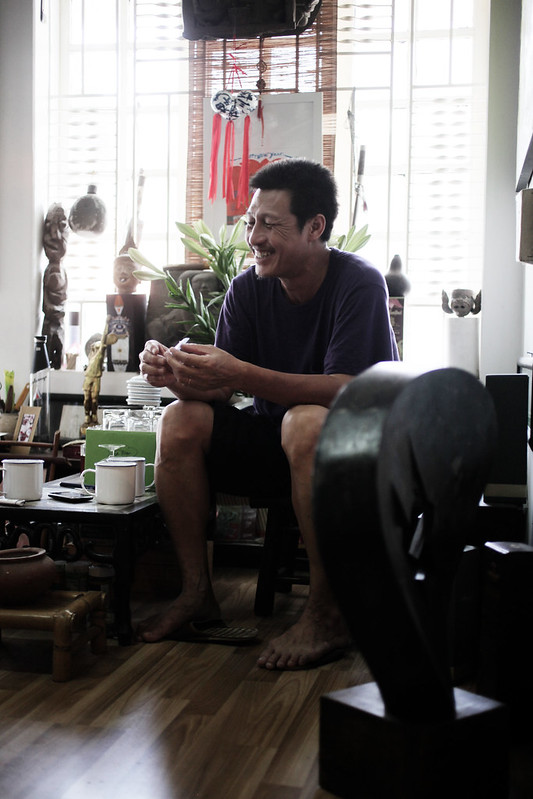
In the Studio with Hà Trí Hiếu

Interview by Đỗ Tường Linh  Photos by Nic Shonfeld  Translation by Maia Do and Tabby Chino

&: How did you first get into fine arts?

Hà Trí Hiếu: Fine arts chose me. I was going for architecture before my father told me how into fine arts he was and that he wanted me to go to arts school. He was a portrait painter, but didn’t teach me his painting skills. Instead he took me to Mr Phạm Viết at No. 13 Thuyền Quang street, and that’s where I started learning about fine arts. At first it felt like I was being forced into it, but then I discovered painting to be beyond wonderful and it has become my life-pursuit ever since.

I see art as a flow that pours out from us, and if you are skillful and imaginative enough, you can direct that flow any which way you want. I love what artist Nguyễn Quân once told me “we just keep painting. If in the end people call us losers and there’s nothing we can do about that, that’s fine with me because painting itself is worth it.”

&: What and who inspires you to create art?

Hà Trí Hiếu: My hometown [Hà Tây] remains my most important inspiration. All of my pieces which depict the countryside contain my childhood memories; the people I grew up with, the fields where I went to find left-over rice and potatoes and the spots where I fed cows and buffalos. It is reminiscing, through graphic language. It just feels right when I dwell in these memories, they make me feel light when I transfer them onto my canvas.

I also draw inspiration from poets and writers. The ancient poet, Nguyễn Gia Thiều, for example. Modern poetry interests me too. I like Đỗ Trung Lai’s works. We are actually pretty close and his verses move me. As for literature, there are authors whose works affects me – the contemporary writer Thiệp for example. I’m fond of his early works that comment on some social issues and describe what he taught in the mountains. That’s what I like.
In the Studio with Hà Trí Hiếu

In the Studio with Hà Trí Hiếu

&: You once said “I lived and knew the purest parts of life in Hà Tây.” Is this the reason elements of life in the countryside are found in your early work and are still present in your art today?

Hà Trí Hiếu: This idea of ‘purity’ is what I mean, when I talk about what living in the countryside meant to me. When I was a kid, I lived quite a peaceful life in a quiet village with my relatives, despite the war. It was the purest space and period of time I ever experienced, partly because I was a refugee, not a villager. Had I been a real villager then, I would not view it in the same light, just like a farmer would never see Hanoi the way city residents do.

Like me, I am neither a man from the countryside living in Hanoi, nor a Hanoian visiting his hometown in the countryside. I am both, and each of the two is distinct. I think people in the countryside cannot grasp the way someone who lives in the city feels about the countryside. Just like someone who lives in Hanoi, might not be able to penetrate urban life like a countryman who has travelled a long way to experience the big city does. Each has a unique understanding of the other .

But when I first started drawing my focus was elsewhere. It was only when I graduated and really started working as an artist that I started drawing elements of my relationship with the countryside which was a major part of who I was and it became a topic still present in my art today.
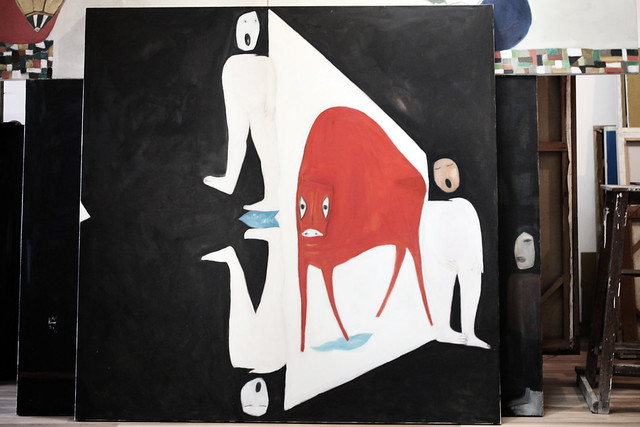
In the Studio with Hà Trí Hiếu

&: How is the countryside today different from the one you knew as a child?

Hà Trí Hiếu: City and countryside are becoming more and more alike. It’s urbanisation. I see karaoke bars and shops displayed exactly as they are in Hanoi. It’s confusing when the city is no longer metropolitan, and the countryside does not differ from the city.

It’s important for a nation when people can tell the city and the countryside apart. That doesn’t mean I do not support development in the countryside, but a rural area has more options in its development than simply copying a city. For thousands of years Vietnamese villages have developed in a way that allowed them to preserve their predecessors’ values. But since the industrial zones appeared in the last ten to fifteen years, the living style of the villagers has completely changed. They pass time with gambling, prostitutes and drugs and seldom spend their money on proper investment. It is all about pleasure.

Newly built houses are copies of Hanoian tube houses that sabotage the old ones that I consider truly beautiful. Had the planners been thoughtful enough, they would have preserved the old architecture.
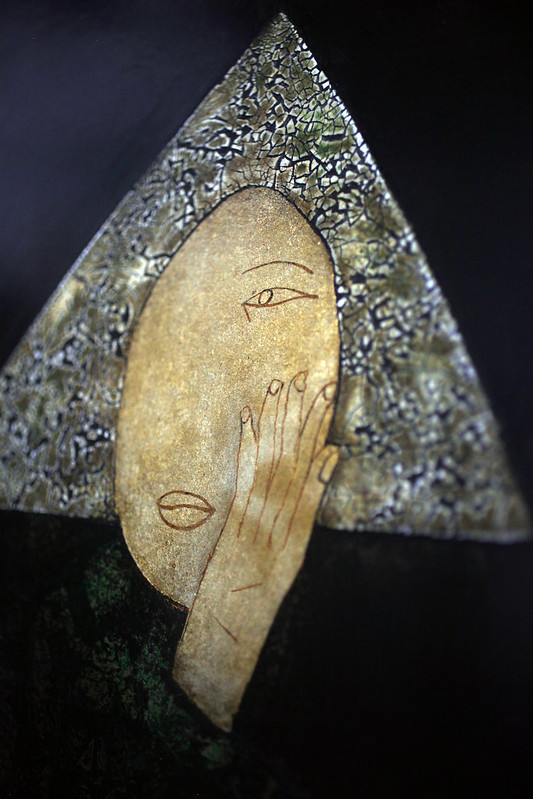


In the Studio with Hà Trí Hiếu

&: Does this mean the topics of your work are changing too?

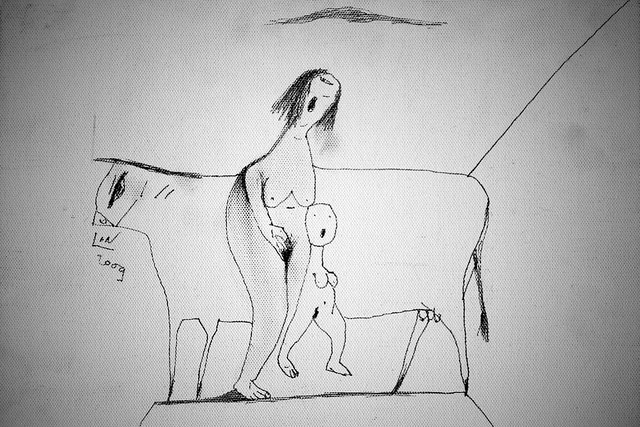
Hà Trí Hiếu: In 2008 I started drawing things that at a first glance don’t seem to be related to the countryside. I drew women and called the series “cổng” (gate). That is what they are to me, gates through which people step into the world. I plan to pursue this idea. Though I haven’t exhibited the work, someone who saw it suggested I change the name into something more easily understood. It was suggested that the association people have with “cổng” is literal. People would think of village gates. But for me all gates are the same. And all of us are gates through which we release our identity.

It is all about survival and purity in human lives, but also human obsession. Those [women] are gates leading to life. So I did my research on it and found this human condition is the same in the countryside and in the city and I could combine the two in the same frame. It takes time; and I have only worked on this idea for a few years so I still have a lot to work on. To figure out how to make the paintings beautiful and, at the same time, philosophical.
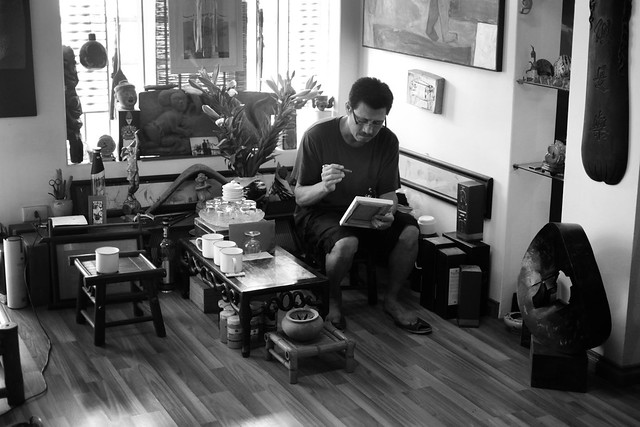
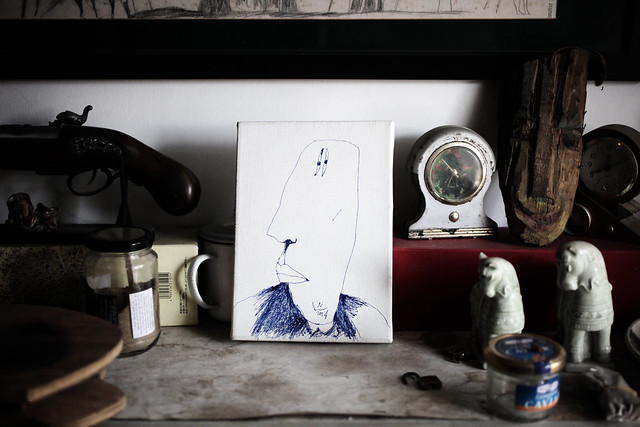
In the Studio with Hà Trí Hiếu

In the Studio with Hà Trí Hiếu

&: How do you go from an idea to a finished drawing?

Hà Trí Hiếu: Drawing is like a conversation, and it only finishes once you sign the painting. As long as you haven’t signed it, the conversation continues. Even when I’m busy the painting is still on the easel, and the conversation goes on between the artist and the picture. The object is no longer a sketch, but something inside me that I have to focus on to bring it into existence. Just like you and me talking at the moment; it’s hard to focus on other things right?

&: Why did you use cardboard whiskey boxes as canvases in your recent exhibition ?

Hà Trí Hiếu: These whiskey boxes belong to my daily routine, they are part of intimate gatherings between my friends and me. I took what is essentially our litter, added something to it and crossed some things out in order to make a more beautiful thing. They are not really works of art though, that makes them sound too grand.

Van Tho, as an instance in painting

The aspiration to revive fresh, innocent emotions of childhood or return to the instinctive life in every human bing does not solely belong to the industrialized, scientific rationalist West; it is omnipresent in the world now that the market economy is step by step infiltrating into everybody's mind, and humanitarian life is more and hampered by the pursuit of wealth and pragmatic apathetic calculations.

Artist Van Tho is seemingly aware of the weariness suffered by this mundane world and himself. And he tries to isolate himself from reality to take refuge in the purified, peaceful realm, which is fine art.

Vietnam Artist Van Tho  Self Portrait by Van Tho
Van Tho is lucky enough to preserve the sincerity and artlessness of a writer or an artist. He boldly departs from rules and conventions, breaks through the previous aesthetic barrier put up by himself to a style of painting which is liberal, instinctive, complex-free, like children's drawings.

He also learns from children the way to come up with a topic for painting in any place, from simple, daily stories to details of man's behavior in everyday life. These may be minor or momentary in the adult's view, but really have a certain meaning in children's mind, viz, the getting dressed, braiding hair, going for a walk all by oneself or more seemingly important events such as: "I got a distinction, Uncle", "Baby is Toddling", "Preparation for a Visit to the Public Garden"....All this may serve as a pleasure, an inspiration for painting.

And he sets about drawing as easily as children starting a game on a happy Sunday. He rejoices at using colors, fabricate fanciful "fine-art" stories utilizing any theme, any fleeting idea in his mind, provided that he could bring his game to an end and immensely release himself, not caring about refinery, prudence or perfection. Sometimes, Van Tho leaves in his pictures occasional patches of coarse, raw colors or scribbling brush strokes, now accidentally now intentionally yet this is always a plentiful freshness of colors and full freedom in creation.

In find Van Tho's taste in fine art so close to Matisse's. This is evidenced by his primary dazzing wild palette or purely eye-pleasing and relieving decoration. At the same time, Picasso's influence bold transformation of figures and a marked primitive imspiration. Van Tho often paints wild, crumpled, disfigured faces, and fictitious, distorted human figures, added here and there by a savage, mystic eye or a rough, weird hand.

The encounter with Picasso and modernist aesthetics has been observed among several Vietnamese young artists, like Tran Trong Vu, Le Quang Ha, Dang Xuan Hoa, Ha Tri Hieu, in the different periods of their creation. We may say that this is quite natural for the following reason:

Vietnam Artists
"Portrait Of Mr. Ham" by Van Tho
The aesthetic revolution of Western modernist artists at the dawn of the 20th century is precisely the relinquishment of rigid, fastidious academic lessons to revert to instinctive art so natural, simple and richly-intuitive. This "primitivization" of artistic language leads to a starting approach close to folk art and children's art. However, the return to a "primitive" as one likes is truly difficult, especially with rationalist Western artists. Many of them, while coming back to instinctive art in an extreme manner, distorted figures weirdly, extravagantly, as in a number of cases of expressionism. The Vietnamese painters' return to instinctive art is mush effortless, as easy as pie, because they art not under the weight of academic art and are surrounded by a living environment imbued with folksiness. No need to go anywhere, they almost instantly meet modern, up-to-date elements in their traditional art rich in folk characters.

Let's talk about Van Tho's art again. He is complexfree and does not waver before outer influences, tardy as they are. He openly expresses his sympathy and friendly response to Matisse, Picasso and the Western modernist artisrs who were the pioneers in the effort to emancipate art from the imposition of traditional concepts and paved the way for freedom to experiment any ideas or media. Van Tho painted the still-life "Nenuphar Flowers 2002" in Matisse's style with a note dedicated to "Les modernes" and Matisse, thus conveying his sympathetic feeling to them. Furthermore, he solemnly drew Picasso's portrait according to his imagination, as a gesture to show his admiration for this talented champion in painting.

Renovation is a natural need of creative work and artists. Van Tho is now at the meeting point of modernist art influences with their "primitive" tendency and children's art, in which he feels himself rejuvenated with the fresh, generous folk palette which is rich in conventional decorative patterns and expresses the most primitive, affectionate and simplest feelings of humans.

Besides, he himself feels satisfaction in experiencing free creative work and practising art for recreation and relaxation.

Bui Nhu Huong

Art History Research and Art Critic

From the Art Magazine No.72 of Vietnam Arts Association

Thứ Năm, 21 tháng 1, 2016

Vietnam artist Ho Quang - master artist

ARTIST HO QUANG

Born in 1929 in Khanh Hoa

Graduated from the Fine Arts Promotion in resistance 1948

Member of Vietnam Fine Arts Association and Hanoi Fine Arts Association

His works can be seen at Vietnam Fine Arts Museum 

Many private collections in USA , France , England , Germany , Singapore , Australia and Hong Kong

Awards :

The 3rd prize of National Fine Arts Exhibition in 1960

The first prize of Vietnamese paintings Contest for Children in 1967

Meday for Vietnam Fine Arts work 

Meday for Vietnamese Literature and Arts work


Thứ Sáu, 11 tháng 9, 2015

Bui Ngoc Tu's Style


Artist Bui Ngoc Tu was born in the contryside of Vu Ban, Nam Dinh, where hometown of the talented people in early modern Vietnam culture that full of Poem Literature Music Painting. There are the talented people that thier names went to the history as a lasting imprint in the memories.


We were admired Nguyen Binh with rustic, country bumpkin poetry soul permeates the neighborhood. A candlelit witty intoxicated poetic voice of Vu Hoang Chuong, a musician untimely Dang The Phong to sob Autumn raindrops, a wandering artist with the Hoang Lap Ngon with Indestinct rolling House is along so engrossed in the movements spread the interesting conversation among fiends. A gentle Tu Xuong is sudden transition even in the old society-new early twentieth century. And Bui Ngoc Tu cannot escape the strong investment gorgeous spread from the giant that of his homeland to make a big name in autumnal still passion, hope.


He graduated from Ha Noi Fine Arts University academic year 1969-1973-a gold school year of a curriculum of schools. Being taught by the professor masters Tran Van Cao, Nguyen Tien Chung, Tran Dinh Tho, Pham Van Don on lacquer , a masterial that the artist Nguyen Gia Tri has spent a lifetime looking to leave a legacy for generation  to massive student receptive and creative in thier learning path. Bui Ngoc Son is one of those hardworking students diligently to reach a true substance of a kinky, aristocratic own a painting corners magical Asia. And as a random karma, similar to Nguyen Gia Tri has spent a lifetime looking to leave a legacy for generations to massive student receptive and creative in their learning path . Bui Ngoc Tu is one of those hardworking students diligently to reach the true substance of a kinky , aristocratic own a painting corners magical Asia . And as a random karma , similar to Nguyen Gia Tri abandoned village in Chuong My Ha Tay to live a quietly life among brilliant Saigon and full of sunny southern land of tropical wind but still draw on a North Land nostalgia painted on familiar sheets . Bui Ngoc Tu say goodbye Hanoi to find Southern studio windy seasons and still remember the Village Festival to be loath to part with scarf and skirts , Love duet night a image of Returning home to pay thanks to ancestors after achieving academic honors at old Southern land at the time of final Han school examinations . They both want to live on a plate painted memories - memories of a Vietnamese culture longevity , sustainability .


Vietnamese Artist Bui Ngoc Tu

"Nude " by Bui Ngoc Tu


Reviewing the work of Bui Ngoc Tu collection we find the sound flow of colors of any form of painting style tones Bui Ngoc Tu lacquer to give a passionate liberal language makes this material into pieces fertile ground for artists unleash emotions endless maneu .


With magnificent golden religion , eggshell lacquer profusely deep harmony interaction , improvisation through several levels : Beating debris , threw and scattered , repressed , gathered ... then danced jubilantly on bare shoulders girl in the painting summer in the picture Rhyme Song, Sunset, Phobias. In the dream of Miss kieu, subtle lullabies at Chinese four -chord lute Song at karma.


Bui Ngoc Tu have read more unusual the art of lacquer ancient instinct had not seen things through the eyes of European telecommunication access only but still carrying the depth deep space  Memories. He put on his work. However, the relationship did not mind that the display of the will, therefore the Ancient aroma of Ha Noi, Song of communal house in the village, menstruation Costumes, Lotus Aroma, Village Festival, which shown on large sheets of lacquer to work pretty package of Sadness, Phobias, Song rhyme, song of Walking on the countryside laden memories, the formation of ghostly, man, woman, Woman with horse is curious, sexy, wild in the abstract space is also inlaid with shell or just the familiar gold.


"The Moonlight Night" by Bui Ngoc Tu


We temporarily take away the lacquer panels splendid golden scales, lacquer abyss to abyss once every hour watercolor painting by Bui Ngoc Tu in Rhamnoneuron paper was from this pinting lacquer to build sustainably. It feels Bui Ngo Tu drawing in Rhamnoneuron paper more flexible, more aggressive boys and girls in the subject faux pas, fertility so that the viewer enters the world of chaos mankind, to see whether there are transient, but the deep of semantically rich in familiar folk. But on the shape itself, breast about Siamese clothes, men women catch crabs and snails, buffalo, fly a kite in the Han diluted ink pen streaks spreadon a sheet of paper with the advent of wake fulness... Bui Ngoc Tu led the viewer to a wild world that there is a region free.


And I love, cherish his work. Thank Bui Ngoc Tu.


By Nguyen Hai Yen - Researches Art Criticism

Dang Can, 1957 | Landscape/Figurative painter


The Vietnamese painter Dang Van Can was born in 1957 in An Duc commune, Long Ho District, Vinh Long Province, the place is located along riverside of Mekong river in Vietnam. He showed an early talent in drawing and painting. He commenced to art works since 1976 with main job as a illustrator for local newspaper and magazine.
Dang Can is a member of Vietnam Fine Arts Association.
He has many paintings in Private Collection in many countries.


For that, step by step, it has brought him to the public who like to take the delight in art.


His style of painting is not only very soft, deep but also very attractive in the peacefulness of Mekong Delta. His paintings bring a full and semplice dream, to be imbrued with poetry, high-faluting but also reality. The main subject throughout his works are the landscapes in peaceful countryside of Mekong delta, the school girl in Aodai, the daily changing of local residents. It’s really simple but also very lovely.


Vietnam Artist Dang Can


Beside painting, he is also a composer/ designer in art of ceramics. He used to take part time job for Art Ceramic Workshop in Vinh Long where the art ceramic products are famous for exporting to many countries in the world.


Looking Can’s art works, we couldn’t stand taking emotionless or nonchalant because he took us to the natural living in the lower section of Mekong river. He wants to show us the human conditions, the sublimates of daily living as well as the lovely sceneries and the reform of our country day by day.


Time to time he will show us more beautiful paintings and he is also a great artist in the Mekong Delta area.


Vietnam Artist Dang Can

Public Opinion and Artworks - Vietnam Artist Van Tho


Reflections on painter Van Tho's book titled "Van Gogh's Eye , Van Tho's Eye - Vietnamese Comtemporary Painting"


Van Tho artist with "Smoking Man" painting


For me , Van Tho has been the first and only artist in Vietnam who is blessed with qualities of the three geniuses of the modern painting world : Picasso , Matisse and Van Gogh . They have four characteristics in common : First , they are motivated by impulsive passion . Second , they reflect the unrest of the instinct of painting . Third , they are all directed toward a sublime art which is universal - extending across national boundaries and not repetitious of traditional motifs , colors and lines . They create a "daunting art". Fourth and last , they are architects of visual art .


Wherever Van Tho's works are placed , they will make the surroundings look lively , splendid , and opulent . They create a respectful and invaluable cultural space . (It would be astonishing to catch sight of his paintings in a rural area.) His paintings have penetrated the era and reached the level that has rarely been surpassed where , the painter discovers a new point of view - an unexpected escape - in technique and in painting processes and use of colour , as well as in the use of metaphor . He has great strength , decisiveness and instinctive intelligence . He has the precision of an architect , along with the painters eye for the use of colors , media and shapes . (That reflects an old persons wisdom but a childs behavior.) And he makes vital use of modern architecture .


Van Tho's paintings contribute to enlivening space and heightening its value . They are best placed in modern , intellectual and simple architectural spaces . They are on a par with the works created by world-famous architects from the past such as Mies van de Rode , Walter Gropius , Louis Kahn and Le Corbusier , as well as young architects in the present days such as Zaha Hadid , Daniel Libeskind and Remkoohaas .


Van Tho's paintings are completely different from the works of other artists in present day Vietnam . They reflect a new language of art , a new way of thinking , and a new way of expression . They also reflect an atypical conception . Viewers can find in his works the "fire" and "emotion" that are rarely found in others .


From his hands and brain , his works emerge beautiful , satisfying , rich and native .


"Portrait of Old Painter" by Van Tho


He is able to find the most unusual object , the most limited or unlimited spaces , the most standard painting medium and color , the closest and most dynamic layout , the most unexpected escape and the grittiest aspect for each of his paintings .


The bigger his paintings are , the more frightening they are . They depict things that surpass the boundaries of the painting size .


His paintings bring fellings to viewers of sublimity , pleasure and strangeness . Each of them is a distinct flame , which cannot be found in any other painters works . Its not advisable to place other painters works near his .


Whenever I find myself hard-pressed for creative ideas , I turn to him . He is a warm bloodstream , a raging flame and a rich source of inspiration for me . I am an architect . I can handle the technical part .


As for the artistic part ,I relyon him . That is enough . To learn from him is to learn from world-famous artists such as Picasso , Van Gogh , and Matisse


He always show  me a soltion to any problem in creating art . Thanks to him , I learnt to be open to any cicumstance . Everything can happen and exist .What a knowledgeable and impulsive man!


Vietnamese Artist Van Tho


 "Smoking Man" by Vietnam artist Van Tho


I have diplayed other painters works in my creative space and found it turned ordinry .I had to replace them with his paintings .They are "expensive " and of high quality .They make my space sublime , holy, and luminous .They feed me with inspiration for actistic creation.


His painting have no need of a specific content or model .He paints on impulse .For hm ,to paintis as if to eat or breathe .He has no need for a target .He pays attention only to expressing on cavas the forms which are smoldering and suffused in him.


He pays little attention to content but more to from . (All great artists seem to be like that!) He is inspired by emotions .As a result his painting are normally not named until they are completed .Objectives are sit in other situation but not in arisic ones .When holding the brush ,he paints without any outcome in mind .Initially , the act of painting takes place spontanneously and unconsiouly .Then comes the intention .He doesnt know what he has created until the works is finished .The title is created as the final stage of the process .


June 10th ,2009


Emotion and reason in painter Van Tho's works


Emotion is perceived with one eye only . Viewers find in Van Tho's paintings aspirations , simplicity , deep-tooted sentiments , excitement , meditations , depression and exuberance . They find the heart , soul and "unconscious" aspect of the artist .


Reason is perceived with both eyes . It tells the artist if he needs to add , lessen or clarify something in his works . It tells the artist that perfection is not impossible and that one thing will lead to another . It has no relation with emotion . It refers to the "conscious" aspect of the artist .


June 21st , 2009


I have not been to Van Tho's house although I have cherished that intention for a long time . I cannot go there to have a look at his painting only . I can only go there with some money in my pocket . What makes me feel most regretful is that I have not been able to afford oneof his paintings .


But I will certainly go there some day (even if to visit him only!)


By Architect Hoang Trinh , Ph.D


Head of the Department of Public Architecture under the Faculty of Architecture Postgraduate training 


Hanoi Architectural University

Meditation from Impressionist style of Minh Long' Art


Minh Long was born in 1968 in Ho Chi Minh City, Vietnam and graduated from Hue Fine Arts College in 1991. Minh Long's art has an impressive style, and creates an impression of zen and calmness with his usage of palette with a slight western influence with his blending and layering techniques. He skillfully creates the atmosphere and feel of each painting, making it seem almost dream-like and unreal.Minh Long's art is a simplicity of Buddhism which is the most identified characteristic in painting. Color palettes like light yellow, grey and brown mixing up to describe the life's sophistication. Some mendicants or monks are receding to infinity. The purity of lotus leaves as well as solemn reddish yellow parasols and the bell ringing are all awaking human beings. These true emotions raise the works out of normal sense to reach noble and pure enjoyment in one's soul.   In a slow and careful approach, the artist does not paint too much like others. Minh Long's art has directed him in a new path with his liberal but efficient brushstrokes to bring up audience to a higher level of life's understanding.


Minh Long paintings are not on a large scale as entertainment paintings. His art is a selection of quintessence of Buddhism which is simple but mysterious. Therefore, ML's paintings have drawn a lot of attention from collectors in recent years. His paintings usually bring to calm and tranquil feelings. Visiting the gallery which is not so crowded or colorful like other types of paintings, audience are attracted by Minh Long art where they can find a deep feeling and all of their worry is released thanks to the soul and the philosophy of the true, the good and the beauty in ML's art like a binding string between reality and consciousness. As long as people are obsessed by their biological needs, they still indulge in ML's art to return to candour. 
His art is a simplicity of Buddhism which is the most identified characteristic in painting. We all know that painting is an artistic science of dimension and colour. In other words, through colour, layout and dimension, a painting will influence people's mind and bring them an aesthetic sense. Moreover, the requirement to dimension in Buddhism art is more strict and sensitive because religion is a philosophy form to explain the world in terms of spirit. It is this factor which has great impact on ML's art, high symbolic and meaningful of mystery. Color palettes like light yellow, grey and brown mixing up to describe the life's sophistication. 


In a slow and careful approach, the artist does not paint too much like others. Beyond the market attraction to return to the sincerity as well as his contrary trend towards fashionable art commonly found in the current economic market, Minh Long art has directed him in a new path with his liberal but efficient brushstrokes to bring up audience to a higher level of life's understanding.


Vietnamese art has been influenced by both Oriental and Western art and Minh Long's art is an illustration. Every artist has his own light. It was scientific in the Renaissance and in Minh Long, it is religious and natural. Ethereal light in ML is appeared in calmly flying clouds, looming yellow - brown - red lap of dress and sound from nothingness. Monks are silently walking to a state of bliss. It reflects an inspiration of self-reconcilement in every one which Minh Long is searching in his way .

Minh Long said:"Neither among a monk, a bell nor a prayerbook could help release anyone. Nevertheless, it shows an inspiration to true heart." Yellow and brown reflect the color of sky and ground, mercy in a diversified life. I think that Minh Long's inspiration is acceptable because of the echo of the bell, the self-reconcilement, which can not be ignored to be grown-up. Minh Long's art has an impressive style, reduction in language and usage of palette. His paintings make viewers out of the normal life. In Minh Long's art, there are only monks' journey to nothingness, bell and purity of lotus, background as flying clouds. By skillful processing, he has created unreal air with drifting and bobbing clouds, non-temporal and mind's light, relating to past's images as well as future's. A simple beauty with religious-minded for all the times. Ming Long's art is oriental aesthetic, simple but sophisticated, dreaming but emotional. 
Viewing Minh Long's art makes us realize the relationship between the artist and Buddhistic philosophy. His paintings are filled with monks, brown red umbrellas, bells in smoky air. Despite any strict viewers, they would certainly be directed to tranquility.


Coming back to real life, we are burdened by workload and upheaval of worries and concerns: greed-hatred-anger-affection. Should we have chance to view Ming Long's paintings, we will get back soon to tranquility. No concern and back to true heart. Monks' journey either for food or on missionary will bring viewers to a state of bliss and forget all the troubles. People's mind is subject to the context. That's the way Minh Long intends to help others by bringing them back to the gentle spirit.


You can view his works at http://www.eyegalleryvn.com